
Bars are convenient foods available at drug stores, grocery stores, hardware stores, gas stations, and convenience stores. You may hear them called nutrition bars, power bars, protein bars, cookie bars, biscuits, or granola bars. Some are crunchy and some, chewy.
You’ll find several flavors of bars. They include cinnamon, brown sugar, fruit, chocolate, and peanut butter.
They are tasty grab-n-go foods that don’t require refrigeration and can satisfy your hunger in a snap. But are they helping your bones?
We set out to examine these bars, and we found that some are better than others. Bars may or may not be helping your bones, depending on your choice.
We give you some ways to evaluate them and choose the ones you want to keep as a grab-n-go option when you’re in a hurry and want something to get you to your next meal.
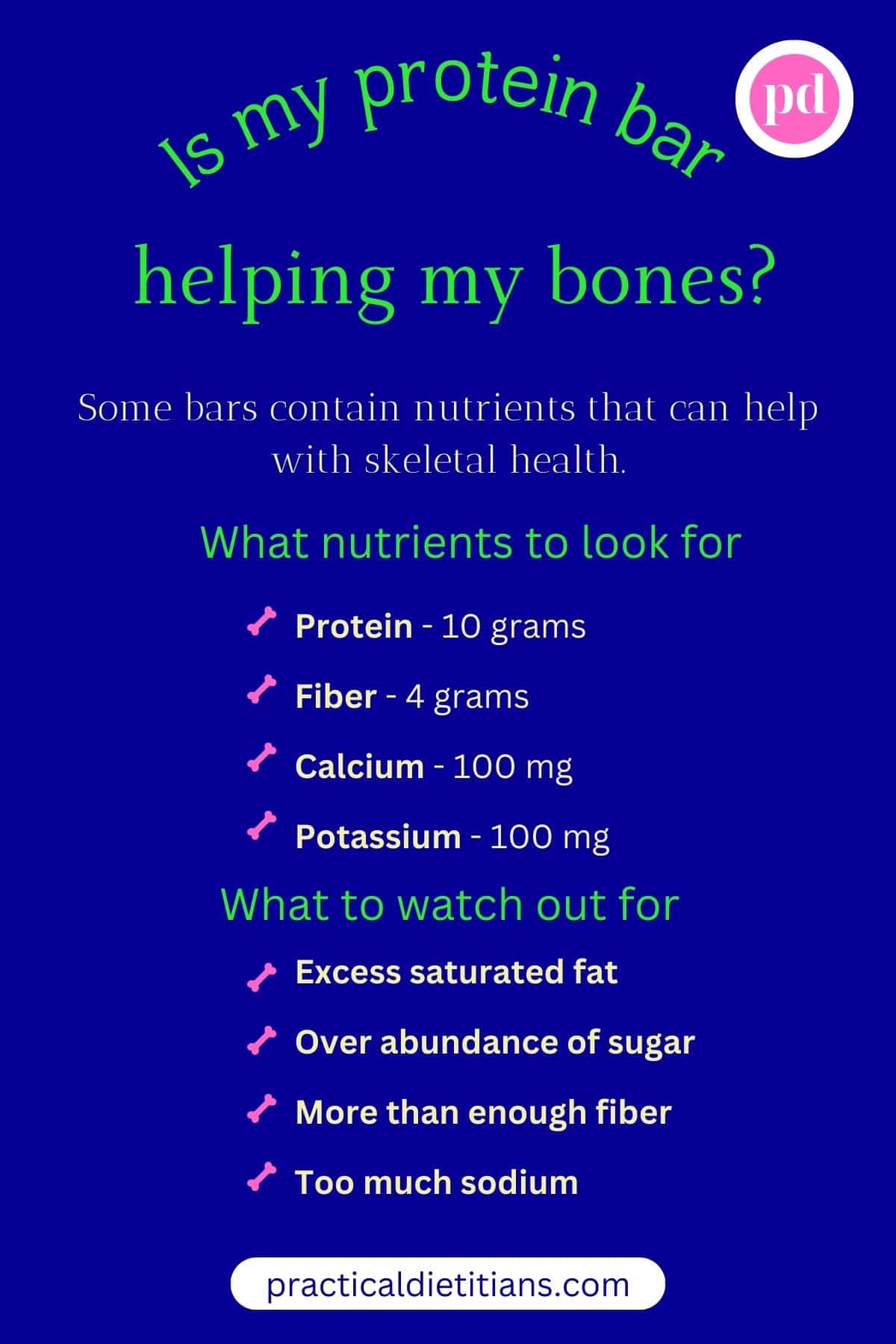
Is my protein bar helping my bones? infographic
What nutrients to look for in a bar
Since women struggle to get enough of these nutrients, we focused on the following nutrients that you can find on the food label. Aim for bars that contain at least
- 10 grams of protein
- 4 grams of fiber
- 100 mg of calcium or 8% daily value (DV)
- 100 mg of potassium or 2% daily value (DV)
Focus on protein
Most bars will not be perfect. Focus on protein and fiber first. We don’t recommend any bar as a regular part of your food intake. They can come in handy, though, for when you are in a hurry, don’t have a refrigerator, or need a simple finger food.
Aim for these nutrients, but if you don’t find a bar that meets all of these, go for one that contains at least 10 grams of protein. If your bar has the minerals we listed, that’s a bonus for your bones.
Protein found in these bars usually comes from whey protein concentrate, soy protein isolate, nuts, seeds, and nut butter.
Remember, these can be helpful, but we don’t recommend them as a meal only, because they don’t provide enough calories. Many bars provide around 200 calories, which isn’t enough for a meal. You may get hungry quite quickly if you only eat a bar.
On the other hand, if you are not a breakfast eater and you have one with your morning coffee, it may work fine for you.
These bars can also come to your rescue as an afternoon snack to tide you over to dinnertime. They are a great go-to when you need something to fall back on.
Bars also make an easy side to have with your salad kit for additional protein.
But be careful! These tasty, convenient foods can become an easy trap to get into.
We don’t recommend including them as a consistent part of your eating pattern.
Fiber as a food additive
Do you ever wonder how some bars have so much fiber?
Like many things in life, fiber is good, to a point. Excessive fiber intake may cause problems that can interrupt your gut and your day.
Be careful with excessive amounts of fiber, as this may cause gas or other unpleasant intestinal side effects. Polydextrose, a man-made fiber, is sometimes used in the food industry.
Chicory root is rich in soluble fiber, which is comprised mainly of inulin. It is a food additive used to increase the fiber content in a food product.
A food additive vs. naturally occurring
Naturally occurring fiber is already in food, such as fruits, veggies, nuts, seeds, and whole grains. Fiber was not added to them as it is in a food bar.
When a bar is particularly high in fiber (5 or more grams), it’s likely not naturally occurring. Rather, it comes from ingredients you may see listed, such as polydextrose, chicory root, or inulin, that give the product extra fiber. Sometimes, it also contributes to stomach upset and may cause gas.
Calcium and potassium
Since these minerals contribute to good bone health and are found in several bars, look for at least 100 mg each. You might also see these listed as percentages of the daily value (DV).
What to watch out for in a bar
Whole grains are good, but just because a product has whole grains doesn’t necessarily make that product good for you. If a lot of sugar, salt, and fat were added to it, it’s not so healthy for you.
Some bars touted as energy-sustaining breakfast foods may be no better than an everyday cookie.
Excess amounts of sodium or saturated fat found in some bars can be harmful to your health if eaten in excess. A surplus of sodium can contribute to calcium loss from your bones.
Too much saturated fat intake can contribute to higher levels of inflammation. For those reasons, we suggest choosing a bar with less than 250 mg of sodium and less than 5 grams of saturated fat.
In comparison, a three-ounce portion of skinless chicken or lean beef would have less than 3 grams of saturated fat. A portion of either would also give you at least 21 grams of protein.
Final thoughts
Protein bars, with their many different names, textures, and flavors, are convenient and can be helpful at times as a snack, mealtime addition, or for non-breakfast eaters. Bars provide nutrition to support your bones.
Women fall short on protein, fiber, calcium, and potassium, so we chose to look at these nutrients. A bar containing sufficient nutrients without excess saturated fat or sodium contributes to good skeletal health. And on fiber, remember that some is good but too much is not.
They can also be an easy trap to fall into, so only including these occasionally is recommended.

Stephanie Turkel is a registered dietitian nutritionist based in Texas. She has 30 plus years of experience in the nutrition field. She now takes her gained knowledge and shares it with you to explain science articles into easy-to-understand information.

Grace Rivers, RDN, CDCES
Grace is a registered dietitian nutritionist residing in Texas. She has over 30 years of experience in nutrition. Grace loves translating science articles into easy-to-understand information for you.